Experience financial decisions before they become real ones.
Finvy Life Simulator gives participants a realistic environment to make financial decisions, experience what follows, and build greater understanding before those choices affect real life.
Make the decision here. Learn before it is real.
Financial concepts make more sense when you have to use them.
Choose
Make real financial choices about work, housing, spending, saving and more.
Experience
See what those choices mean for a simulated financial life.
Adjust
Change course and see how the picture shifts.
Learn
Understand the reasons behind the results, not just the numbers.

Learning can explain what something means. Experience helps show why it matters.
Every decision becomes part of the bigger picture.
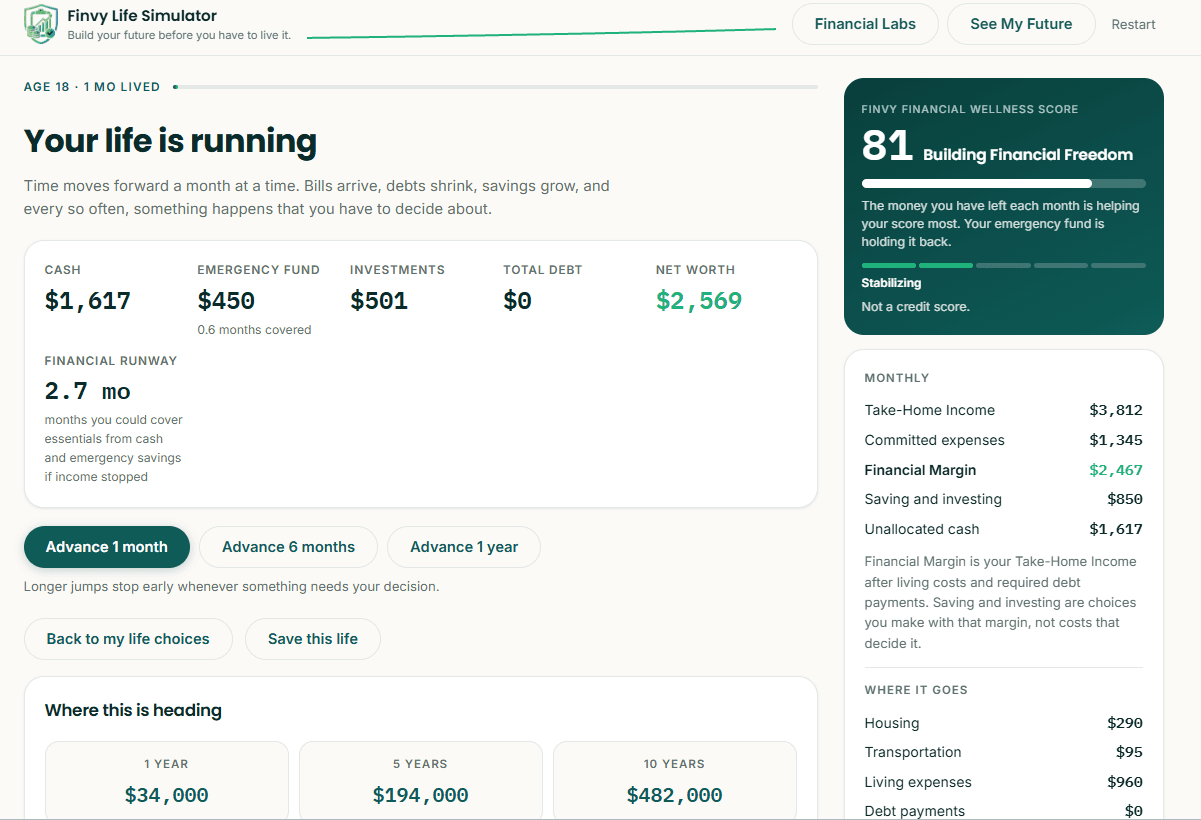
Participants don't answer disconnected questions. They build a financial life one decision at a time, then live it month by month as bills arrive, debts shrink, savings grow and life sometimes surprises them.
In the College and Emerging Adult experience, participants build their plan and see it projected month by month.
How a life comes together in the Middle and High School experience
- EducationChoose a path after high school
- CareerPick a career and a starting salary
- PaycheckSee take-home pay after taxes
- HousingDecide where to live
- TransportationDecide how to get around
- SpendingSet everyday spending
- Saving and investingBuild an emergency fund and invest
- Life in motionAdvance month by month and respond when life happens
One decision can change what happens next.
Situation
A choice appears, or something happens that needs a response.
Decision
Participants weigh the options in front of them and choose.
Consequence
Cash, savings, debt and net worth change, with feedback that explains why it matters.
Next decision
The results carry forward and shape what comes next.
Financial decisions involve tradeoffs. Finvy gives participants a place to experience them.
Financial decisions change as life changes.
- One shared experience
Middle School
Introduce foundational financial decisions through the shared Middle and High School experience.
- One shared experience
High School
Prepare for greater financial independence and increasingly complex financial choices.
- A distinct experience
College and Emerging Adults
Explore financial independence, income, obligations, career transitions, and real world financial responsibilities through an experience designed for this stage of life.
Middle School and High School share one Simulator experience, where a simulated financial life runs month by month. College and Emerging Adults use a separate experience built around interactive financial projections, from paying for college to a first year of work.
Participants do more than answer questions. They make decisions.
Education and career
Paths after high school, careers and starting pay.
Income and taxes
What a paycheck really looks like after taxes.
Housing
Living with family, roommates or on your own.
Transportation
Public transportation or a vehicle, and what each costs.
Spending and priorities
Everyday choices and the tradeoffs between them.
Saving and resilience
Emergency savings and how long they would last.
Debt
Student loans, car loans and credit card balances.
Investing
Monthly investing and the long view.
Paying for college
Costs, funding sources, loans and work while in school.
Financial learning continues with every decision.
- 1
Enter
Join through your organization and choose a journey.
- 2
Decide
Make choices about work, money and everyday life.
- 3
Experience
See the results unfold in your simulated financial life.
- 4
Adjust
Change some choices, or start a new life and compare.
- 5
Continue
Keep going. Every new decision builds on the last.
Financial readiness is not a grade or a competition.
There are no leaderboards, no rankings and no one to beat. Participants see how their own choices shape their own financial picture, and they can change course to understand why the results moved.
The goal is not to create the perfect financial life. The goal is to understand financial decisions more deeply.
An experience designed to support the conversation around it.
Finvy Life Simulator gives participants something real to talk about, and gives the people leading them the tools to run a structured program.
- A facilitator dashboard with program level results
- Financial Readiness check-in and follow-up for participants
- Results organized by class or group
- Financial Labs for focused practice
- Organizational Impact reporting
Understand where participants begin. Then give them something to experience.
Financial Readiness helps facilitators understand a starting point. Participants complete a check-in, use the Simulator, and later complete a follow-up. Facilitators then see observed change for the program, not a verdict on any one person.
A starting point
A check-in shows where a group begins.
Something to experience
The Simulator gives participants decisions to make and consequences to see.
Observed change
A follow-up shows observed change across paired participants at a program level.
Five readiness areas
- Money Management
- Debt & Credit
- Savings & Financial Resilience
- Financial Decision-Making
- Future Planning
Financial Readiness is optional, and the Simulator works on its own. Observed change describes what was measured. It does not show that any single experience caused it.
A financial life and focused financial decisions serve different purposes.
Life Simulator
A broader financial experience where financial decisions interact across the participant's simulated life.
Financial Labs
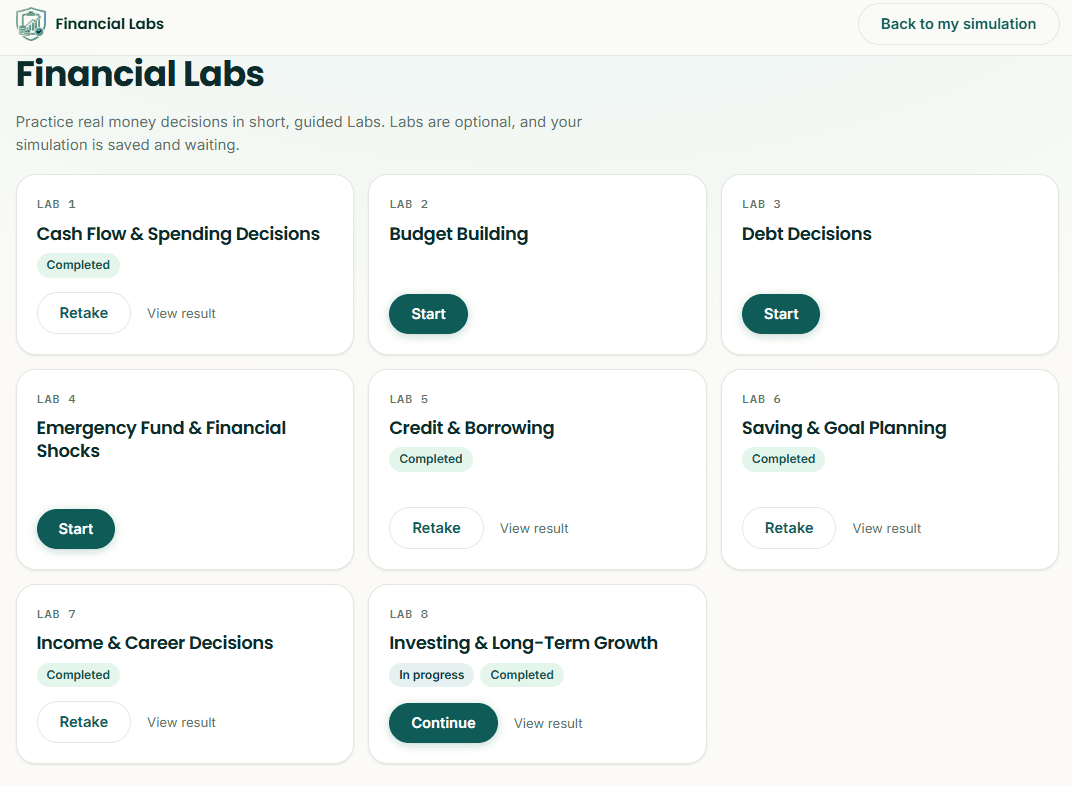
Eight focused experiences that let participants explore specific financial decisions and concepts more deeply.
The eight Financial Labs
- Cash Flow & Spending Decisions
- Budget Building
- Debt Decisions
- Emergency Fund & Financial Shocks
- Credit & Borrowing
- Saving & Goal Planning
- Income & Career Decisions
- Investing & Long-Term Growth
The Simulator shows how financial decisions connect. Financial Labs give participants focused opportunities to explore specific decisions more deeply.
Turn participation into something organizations can understand.
Facilitator and organizational reporting brings the program into view, so organizations can see how participants took part and what changed.
Participation
Who started, who is active and how many have completed.
Financial Readiness
Check-in and follow-up results, readiness areas and observed change.
Financial Labs
Lab participation and the skills participants practiced.
Organizational Impact
A program report that can be printed or saved as a PDF.
Measure the program, not the person.
Reporting focuses on groups and the program as a whole, and small groups are protected. It is built to help organizations understand their program, not to grade individual participants.
Built for financial learning across organizations and communities.
Wherever people are learning to make financial decisions, Finvy Life Simulator gives them a place to practice.
- Schools and Districts
- Colleges and Universities
- Nonprofits
- Churches and Community Organizations
- Financial Wellness Programs
Give facilitators the structure to lead the experience.
Finvy is not only participant software. Facilitators have their own dashboard to organize and follow the program.
Their own sign in
Facilitators sign in to a dashboard for their organization.
Classes and groups
Organize participants into classes or groups and view results by group.
Program results
Simulator, Financial Readiness and Financial Labs results in one place.
Ready to share
An Organizational Impact report that can be printed or saved as a PDF.
Designed for organized programs, classrooms and cohorts.
- Organization based access
- Finvy sets up a program for your organization.
- Participant access
- Participants join through their organization. No name or email address is required.
- Facilitator access
- Facilitators sign in to their own dashboard.
- Audience configuration
- Organizations choose which audiences their program includes.
- Structured delivery
- Programs run for a set period, with participants organized by class or group.
Frequently asked questions
What is the Finvy Life Simulator?
Finvy Life Simulator is a financial life simulation. Participants make decisions about education, work, housing, transportation, spending, saving, debt and investing, and see what follows, using simulated money.
Is the Finvy Life Simulator a game?
No. It is a simulation. There are no points, leaderboards or winners. Participants make financial decisions and see how those decisions shape a simulated financial life.
Who is the Simulator designed for?
Middle and high school students, college students and emerging adults, through programs offered by schools, colleges and other organizations.
What age groups can use it?
Organizations can offer it to Middle School, High School, and College and Emerging Adult audiences. Middle School and High School share one experience. College and Emerging Adults use an experience built for their stage of life.
Does the Simulator use real money?
No. Everything in the Simulator is simulated.
Do participants connect bank accounts?
No. Participants never connect bank accounts or share real account information.
How long does a simulation take?
There is no fixed length. Participants move through the experience at their own pace and can keep going, so organizations can decide how much time their program gives it.
Can an organization use its own curriculum?
Finvy Life Simulator is a web based experience, so organizations can use it alongside the instruction they already provide. Request a demo to talk through how it fits your program.
Does Finvy provide facilitator materials?
Facilitators get a dashboard with program level results, Financial Readiness and Organizational Impact reporting. Request a demo to discuss what your program needs.
Can organizations measure participant progress?
Organizations can see program level results, including participation and, with Financial Readiness, observed change between a check-in and a follow-up. Reporting focuses on groups rather than on individual participants.
How is the Life Simulator different from Financial Labs?
The Life Simulator connects many decisions across a simulated financial life. Financial Labs are eight focused experiences, each built around a specific financial decision or concept.
How does an organization get access?
Finvy sets up a program for your organization. Participants join through your organization, and facilitators sign in to their own dashboard. Request a demo to get started.
Give financial decisions somewhere to become experience.
Bring Finvy Life Simulator to your classroom, campus, organization or community and give participants a place to practice financial decision making before the stakes are real.